_ANZ-Group-shot_v2.png?w=100&v=f3a4afac-70ac-4758-8474-ff17fe163b1c&itok=Z_Qi2FlQ)


.png?w=100&v=76611618-74f9-4150-85bd-f3f88e49eece&itok=5ehAJg_Q)


.png?w=100&v=5053a26b-c336-46d9-b44e-ab91738f07c9&itok=efvsqCNL)


.png?w=100&v=d5f9955a-145e-481e-8081-5ddf4d74c7cc&itok=hKuNtBOw)


.png?w=100&v=2695a42f-b099-4e31-bdbd-c1b445ff88c0&itok=Md9-7E8t)


%20(2).png?w=100&v=a9b7928b-cece-4e51-b913-62ae316129a9&itok=fEHREjki)
_ANZ-Group-shot.png?w=100&v=72a4a24c-7670-47f7-a68e-edeaafa41c8d&itok=k25pq8iJ)
_ANZ-Group-shots.png?w=100&v=4d5e1cd2-60a9-45da-bcfb-1b8500ccaea9&itok=v6A67Pxg)


Drill into timber, soft metal and hard materials including brick and concrete with the RYOBI 18V ONE+ Hammer Drill.


Leaf blowers are a simple-to-use garden tidying tool – the ideal replacement for a rake and broom. So, say goodbye to the tiresome chore of raking the lawn or sweeping paths. Just point and squeeze your leaf blower’s trigger. Then watch the leaves take off.

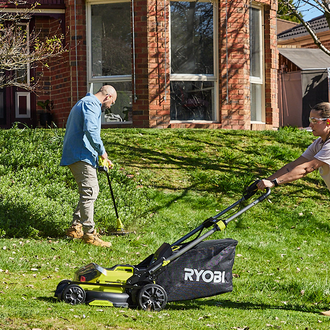
Traditionally, autumn is the season when leaf blowers earn their pay. But while fallen leaves might not be a nuisance year-round, the same can’t be said for lawn clippings. Leaving them strewn across drives, paths and nature strips is not only unsightly, but they can also become slippery, too, when it rains. And leaving them to rot on the lawn can also damage the grass. Using a leaf blower after mowing only takes a few minutes to get surfaces cleaner and safer.
Many of us have memories of being woken early on a Saturday or Sunday morning by the deafening sound of a neighbour’s petrol blower. But nowadays, with the proliferation of quieter battery-powered models (including RYOBI’s Whisper Series blowers that include special noise-dampening features) sleeping in on a weekend can still be enjoyed. And the increased power and control found in RYOBI models means they can be used for shorter periods while still achieving the desired results.
RYOBI has two types of blowers – jet fan and centrifugal fan. Jet fan (axial) blowers are usually referred to as Jet Blowers, while centrifugal fan models are usually referred to simply as Blowers. While both types of blowers shift leaves and debris, there is a difference between them – namely, speed vs control.
As an example, if you have large piles of leaves and debris to move from expansive lawns or open concrete areas and you basically just want to blow it all back into a garden bed, then a jet (fan) blower is a practical solution. But if you have leaves or grass clippings on a path beside a pool or a deck and want more direction where the debris goes, then a centrifugal blower might be a better choice.
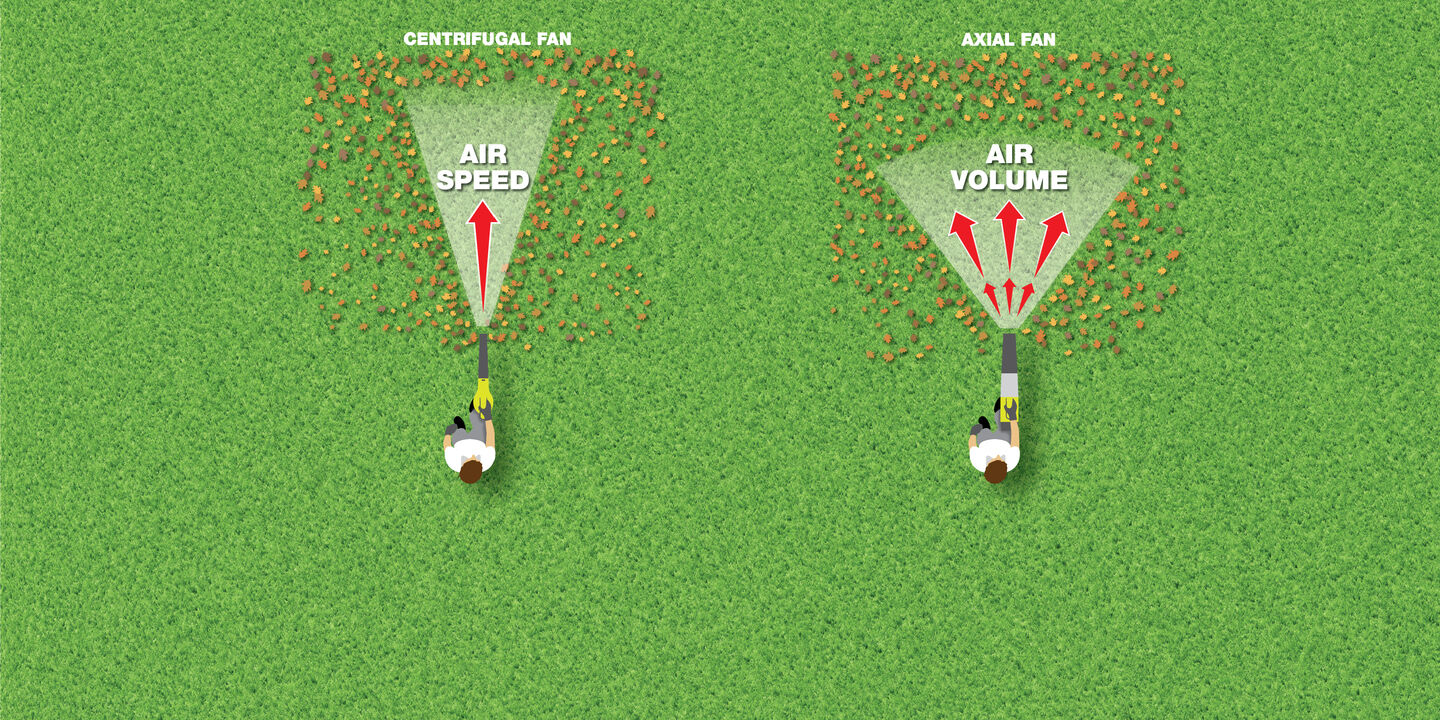
Jet blowers are engineered to blast out air in a wide pattern to move large piles of leaves as quickly as possible. Jet blowers are defined by their design – a straight tube where air is sucked in one end and fired out of the other – with no impediments along the way. Some models have a detachable speed nozzle for more focused airflow that generates even faster air speeds for hard-to-shift debris.
The second type of blower uses a centrifugal fan for its blowing force. These Blowers usually have a round fan housing near their handle where the air is sucked in, spun around in a centrifuge and shot out faster than when it entered the air intake. These blowers offer better air direction control over jet fan models due to their wider range of speeds and narrower tube. Some models also include a detachable speed nozzle for faster, more directed air flow, great for removing heavier, stubborn or damp debris.

Many leaf blowers specify CFM as a number as one of their features. CFM stands for Cubic Feet per Minute, or air volume. Basically, it means how much air is sucked into the blower and forced out the other end.

The other notable figure is km/h (kilometers per hour). This number refers to the speed at which the air (volume) is forced out of the blower.

Some models of leaf blower also have a specification called Blow Force. Blow Force is the measure of how strongly air acts upon a surface. This is determined by the combination of air density, area and velocity. Blow force is measured in Newton’s Force (N). Blowers with a higher N rating are more powerful. In some instances, Blow Force is used to replace CFM and Km/h references.
Want to get more out of your leaf blower? If you’ve just washed your car and don’t want to leave water marks all over the clean paintwork, a leaf blower is a great way to dry it. It’s like a giant hair dryer for cars. It also takes less effort than using a chamois. Leaf blowers are excellent at getting into all the nooks and crannies that can be hard to dry with a cloth, including grilles, wheels, side mirrors and wheel arches.
Leaf blowers are great for blowing the dust and sand off caravan floors (on the lowest setting) after a holiday. Blow a tent clean after camping before packing it away. Use a leaf blower to clean a trailer after a trip to the tip.
RYOBI has a range of leaf blowers and blower vacs that make clearing your outdoor areas quick and effective.
For more in-depth advice, read garden guru Jason Hodges’ articles on garden maintenance.

.png?w=100&v=6c04e2a3-04b9-449c-97a0-86f8df82dcb1&itok=D7d8Umfz)

.png?w=100&v=07272864-2df4-45f0-aa93-568aa3920466&itok=Lj7SSICT)

.png?w=100&v=4297d0f7-8d6a-4632-bff2-7c593a97d3cb&itok=fnsLcLhG)


.png?w=100&v=6fe76245-ac4a-4aa3-986d-04347f143028&itok=dFif4A99)


.jpg?crop=yes&k=c&w=690&h=690&v=1038f508-82d9-4838-8284-a24b731b3b78&itok=ZuNGnwiR)